


The virtual assistant industry is one of the fastest growing industries on the internet.
Thanks to the technologies available today, it has never been easier to work from home. People all over the world are setting up home based businesses out of a desire for independence, flexibility and control over their destiny.
All of these new businesses could potentially use the services of a Virtual Assistant.
However, many people still don’t quite understand what a Virtual Assistant is.
Let’s explore the 7 Things You Must Know About the Virtual Assistant Industry.
No. #1: What is a Virtual Assistant?
The best way to describe the Virtual Assistant role is to briefly explain what I did this week.
Working from my home office with several different clients, I:
- typed some reports for a consultant and emailed them back
- designed a Power Point presentation for a speaker. He was presenting at a conference overseas the following day. I emailed it back to him and uploaded it to his website
- designed and organized the printing of a flyer for a singer who has a performance coming up
- set up and sent out a newsletter for a finance broker
I did all this without seeing or meeting any of the clients: we spoke on the phone and/or emailed each other. Some of my clients are local, some are long distance.
Think of the Virtual Assistant as a freelance administrator, designer, organizer, desktop publisher, researcher, editor, typist, secretary, coordinator, all rolled into one!
Rather than being an employee, a Virtual Assistant is an independent contractor and business owner in their own right.
Clients enjoy the flexibility of using a Virtual Assistant as and when they require, without having to pay a regular wage or employee benefits. This means huge cost savings for clients, as they are only paying by the hour for actual work done.
There is an increasing demand for Virtual Assistants, as more and more people realize their true benefits. The future of the VA industry is certainly looking bright.
—
Don’t Miss: The Virtual Assistant Industry page on this website that provides images and an in depth overview of the industry fro someone who is looking to hire a VA. The page includes types of VA services, how to submit an RFP for a VA, how to find a VA, the initial consultation discussion and more
—
No. #2: Know what you can offer in the virtual assistant industry
You’re full of enthusiasm about starting up your VA business. There’s nothing you want more than to be working from home, earning money in your own right.
You know you’ve got skills and so much to offer. You want to dive in, get business cards done, do some advertising and networking – get clients as soon as possible.
Surely it can’t be that complicated? Well, yes and no. Before jumping in, take a look in the mirror.
There are certain attributes that you need in order to be a success in the virtual assistant industry.
Some of these are:
- Being patient and persistent
- Being disciplined
- Being a self starter
- Being optimistic
- Being able to work independently
- Having an interest in technology
Regarding skills, go through your resume with a fine tooth comb, analyzing all your previous and current jobs.
What about skills that don’t always appear on resumes, such as being able to multitask? Don’t underestimate the value you can offer your clients.
You need to be fully aware of all your skills before you can market yourself effectively in the virtual assistant industry.
What about your interests? Just because you’re good at typing doesn’t mean to say you should do it, if you don’t enjoy it.
Without a thorough look at your skills and interests, you won’t know what services you should be offering now, and what services you could be offering later, with some training. For example, do you need to brush up on your computer skills?
To work as a Virtual Assistant, you need to know how to use Microsoft Office.
In summary, take a good look in the mirror at your skills and attributes – you may be pleasantly surprised at what you see!
No. #3: Do a business plan
Have you heard of the saying: ‘If you fail to plan, you plan to fail?’ This especially applies in business.
If you want your VA business to be successful, put time and effort into a business plan.
At the moment, all you have is an idea. What you need now is to develop a written road map of how you are going to realize that idea.
Think of it as the place where you brainstorm:
- Your vision and goals
- Legal and financial aspects
- What services you’re going to offer
- How much you’re going to charge
- What equipment you need
Traditional approaches to business planning make the whole process seem a little tedious. It doesn’t have to be that way!
I believe that it should be a fun, creative process. It shouldn’t be about slaving over a boring old document from a sense of duty, and then shoving it into the back of your drawer.
I look upon the business plan as an evolving, exciting, integral part of a business, where you are free to brainstorm ideas on an ongoing basis.
I certainly don’t think it is something that you try and get perfect first time round.
In fact, your business plan will never have a final draft and rightly so! It is an ongoing project which can be adjusted as your business grows and you learn what works best for you.
You should review it at least every few months, because it will change and evolve all the time.
You will be ahead of the competition if you follow this tip and prepare your plan!
No. #4: Develop a marketing plan
As part of your business plan you need a marketing plan! Firstly, how much money do you have available for marketing?
There are many ways you can promote your business for free such as:
- telling everyone what you are doing
- writing and submitting articles
- registering with business directories and VA networks
- participating in online discussion forums
- volunteering in your local community
- using an email signature
However, you’ll still need funds for business cards, attending networking functions, setting up a website, advertising and so on.
Who will you be marketing to? Do you have a specific target market in mind?
Or will you be marketing to all and sundry, hoping someone will notice? In my experience, this approach doesn’t usually work, because you are trying to reach too many people.
Your message will be too general.
A very effective marketing strategy is to target a niche i.e. a narrow section of the market such as real estate agents, financial planners, or authors. That way you can tailor your message to them, use their language and stand out from the crowd.
How are you going to reach this target market? Do you know what their needs are?
Who is your competition? And how are you different from them? What is unique about you?
How are you going to get your message across and convince prospects that they need you?
When talking to potential clients, don’t just reel off a list of your services. You need to communicate the actual benefits and tangible results of your services to your target market.
A SWOT (Strengths, Weaknesses, Opportunities and Threats) analysis is an extremely useful tool for developing an effective marketing plan in the virtual assistant industry.
Here’s an example of a SWOT analysis for the virtual assistant industry:
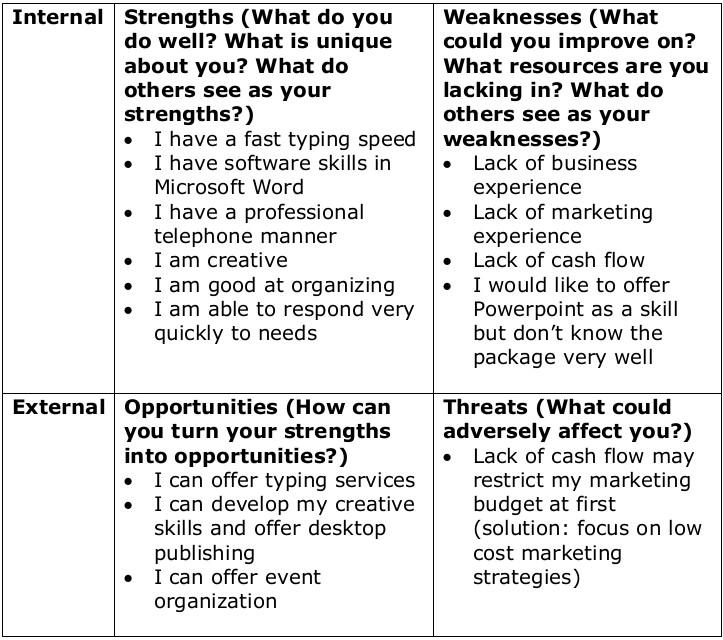
Notice how strengths are turned into opportunities, and how weaknesses can lead to threats?
Identify your strengths and how you can capitalize on them. Be honest with yourself – what are your weak points and
how can you work on them?
Opportunities come from your strengths. The key to making the most of opportunities is to be aware of them in the first place.
Threats come from your weaknesses. Everyone has some! Once you’ve recognized your weaknesses you can look for ways to improve, for example by taking some training.
No. #5: Don’t undercharge for your services
I know what it’s like when you’re starting out in the virtual assistant industry. You just want clients and you want them now.
So what if you have to discount your services to get business? So what if you undercut your competitors to stand a better chance?
Did you go into business to sell yourself short and lose money? If you remember only one thing from this blog post, then remember this:
You must charge a reasonable hourly rate so that you can cover your overheads and earn a reasonable amount of money.
Even though you’re working from home and not paying office rental costs, you’ll have a myriad of ongoing and one off costs for marketing, equipment, stationery and so on.
You’ll also need to fund your own retirement, and put money aside for holidays and sick leave.
Therefore, as a rule of thumb, you must charge roughly two and a half to three times the hourly rate you would earn as an employee.
Some VAs post their hourly rates on their websites, so do some research and get a feel for current market rates.
The other downside of charging too little is that clients may even be put off if your rates are too low. I know I certainly wouldn’t trust the cheapest VA or any other service provider for that matter.
People really do believe that you get what you pay for.
Also, clients at the lower end of the market will tend to be penny pinchers, haggling over every penny.
However, by all means stay flexible. What if you sense that a client could turn into a long-term retainer, but you just need to get your foot in the door?
Use your intuition and judgment when working in the virtual assistant industry. But don’t get into the mindset of discounting your services to get clients.
—
Don’t Miss: The Virtual Assistant Benefits web page on this website. Take a quick assessment to learn about virtual assistant benefits.
—
No. #6: Make your website a priority
The Virtual Assistant works virtually, and therefore is expected to have an online presence.
I would say that setting up a website is something you should do in the early stages of your business.
It can be the first impression people get of your services, therefore a professional looking site is important.
You could learn the skills and design it yourself. However, only do this if you are confident that the result will look professional.
Alternatively, pay a web designer – it is quite cost effective nowadays to get one designed.
Give consideration to the look of the site. Keep it clear and clean.
It must be professional, easy to navigate, and fast to load.
Avoid heavy use of graphics and photos, because this slows down the load time. In today’s fast moving internet world, prospective clients will not wait long before they click on to another site.
Draw up a plan of the site.
Here are some suggestions for pages for your virtual assistant industry website:
- Home
- About Us
- What is a VA?
- Services
- Rates
- Testimonials
- Contact Us
Regarding what to put on your site, always write with your target market in mind. Web copy must be easy to read. Use short sentences and get to the point quickly.
Setting up a website is only the first step. You have to promote it otherwise it will just languish there in
cyberspace!
There are a multitude of ways to promote your website such as getting listed in search engines, participating in forums, using an email signature, getting listed in directories and writing articles.
No. #7: Get support from your family
Depending on your situation, you may have a spouse or partner, and/or children.
Running your own business is one of the most rewarding and challenging things you’ll ever do. Make sure your family is behind you every step of the way.
Is your spouse/partner the supportive type? How about your children? Will they understand when you need to ‘lock yourself away’ and get that project done?
It’s easy to underestimate the impact that running a business from home can have on your relationships.
That’s why it’s crucial to get support and understanding from family members right from the start.
7 Things You Must Know About the Virtual Assistant Industry
I wish you all the best with your VA business.
Here is a summary of ‘The 7 Things You Must Know About the Virtual Assistant Industry’:
- No. #1: What is a Virtual Assistant?
- No. #2: Know what you can offer
- No. #3: Do a business plan
- No. #4: Develop a marketing plan
- No. #5: Don’t undercharge
- No. #6: Make your website a priority
- No. #7: Get support from your family
Take the necessary action and follow these powerful tips. If you do, then you’re already way ahead of the competition! Before you know it, you’ll be making a full-time income freelancing from home!
Learn more
How to Become a Virtual Assistant in 6 Steps
Starting a Virtual Assistant Business in Canada: A Comprehensive Guide